
You have heard time and time again to get vaccinated, but you are confident your immune system will create antibodies, the soldiers that will fight off invading pathogens. Well, that is not always the case. COVID-19 is not the common cold. It disrupts your immune system, hindering its normal functions. Researchers in 2020 conducted a study on both, patients who died from COVID-19 and patients with active infections. The results created a wave among scientists pushing the importance of the COVID-19 vaccine.
Three takeaways to tell your friends:
- T and B cells function to recognize and destroy pathogens in the human body.1
- T and B cells work together to form germinal centers, which mass-produce antibodies to target the infectious pathogen.1
- COVID-19 infection prevents T cells from signaling B cells to form germinal centers, resulting in a complete loss of antibody-producing germinal centers.1
How does your immune system work? Excellent question. A foreign pathogen enters the body via blood, sex, food, air, etc. The pathogen is consumed by an antigen-presenting cell (APC), like pac-man. The APC then displays a portion of the pathogen on an exterior receptor to alert the T cells. APC informs T cells of the pathogen by antigen-presenting the portion of the pathogen to the T cells (Figure 1). The T cells then mature and multiply. These matured T cells will activate B cells (Figure 1). Activated B cells will multiply and begin creating functional germinal centers. In germinal centers, B cells rapidly multiply and test their ability to bind the portion of the pathogen. Those that bind to the pathogen will thrive, and the rest die. The remaining strong-binding B cells are now ready to release antibodies, knowing that their antibodies will bind strongly to the pathogen (Figure 1). Some B cells become memory B cells and roam the bloodstream for decades, ready to fight the pathogen. That is how we achieve mass production of antibodies and long-term immunity.
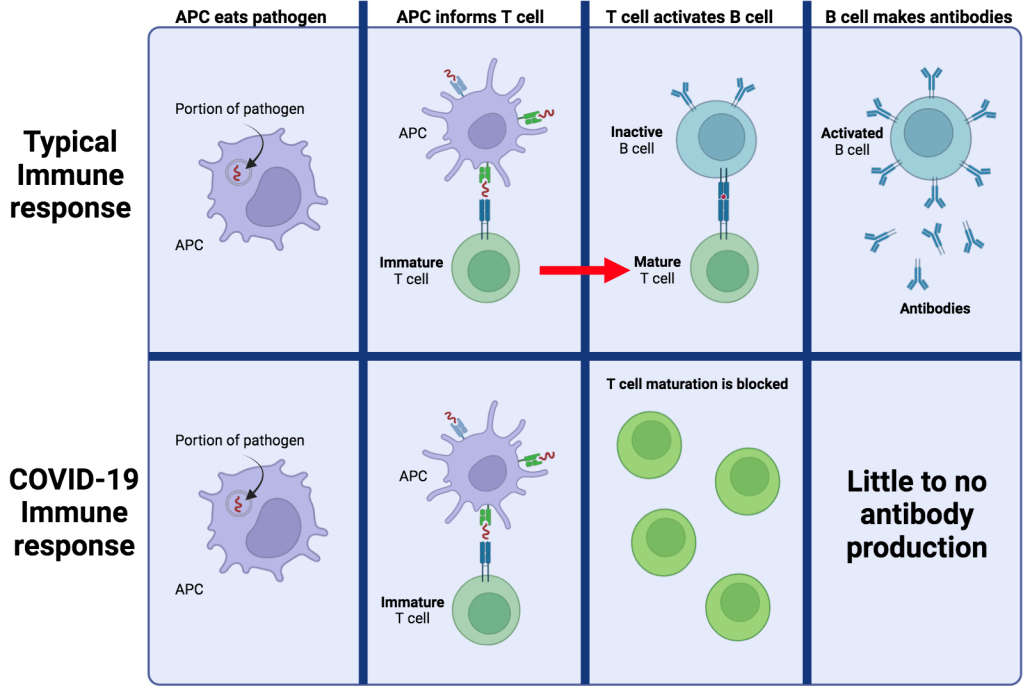
To make it more clear, here is an American football example. The foreign pathogen, or COVID-19, is the coach. The APC is the quarterback. T cells are the players. B cells are the ball. Germinal centers are the endzone. The quarterback (APC) gets the play from the coach (COVID-19) and relays it to the players (T cells). The players then activate the football (B Cells) by sending it to the endzone (Germinal centers). In the endzone, the football releases antibodies to attack the coach. My analogy can only stretch so far.
Now that you are an expert in immunology, we can talk about how COVID-19 disrupts your natural immunity. When COVID-19 enters your body, your immune system attempts to remove it. However, when infected with COVID-19, the number of immunity cells in the body significantly decreases.2,3 Specifically, there is a significant loss of the two cells responsible for developing germinal centers, B cells and a mature form of T cells essential for germinal center formation,1 which is likely responsible for the loss of germinal centers1 and the inability to produce antibodies against a COVID-19 infection.1
One chemical released in our bodies during infection is tumor necrosis factor alpha or TNFa. TNFa is a pro-inflammatory factor, meaning it will signal for inflammation to occur, promote tissue repair, and recruit immune cells. TNFa is beneficial, in moderation. TNFa levels are very high in COVID-19 infections. As stated, germinal centers do not form in COVID-19 infection.1 Does that happen in other infections? Yes. More importantly, TNFa signaling is a factor. In either severe malaria4 or a bacterial infection,5 blocking TNFa signaling allowed germinal centers to form. Potentially, the presence of high TNFa levels in COVID-19 infection prevents the maturation of T cells into the germinal center subtype, thereby preventing germinal center formation. That is a starting point for understanding how COVID-19 evades our immune system.
You may have heard the term “cytokine storm” as it is a feature of a COVID-19 infection. Briefly, a cytokine storm is a substantial release of chemicals alerting the body to a problem, and the vast amount of chemicals can damage organs and lead to death. Consider an orchestra playing music to a crowd. The crowd is the human body being comforted by the music (chemicals). But now the trumpeter is playing off tempo, then the cellist, the flutist, the pianist, and so on, as the crowd tries to follow each tempo. This madness results in the crowd breaking down due to the overload of signals. A cytokine storm results in a flood of signals that your body responds to, but due to the rapid size of the signals, the response causes internal damage.
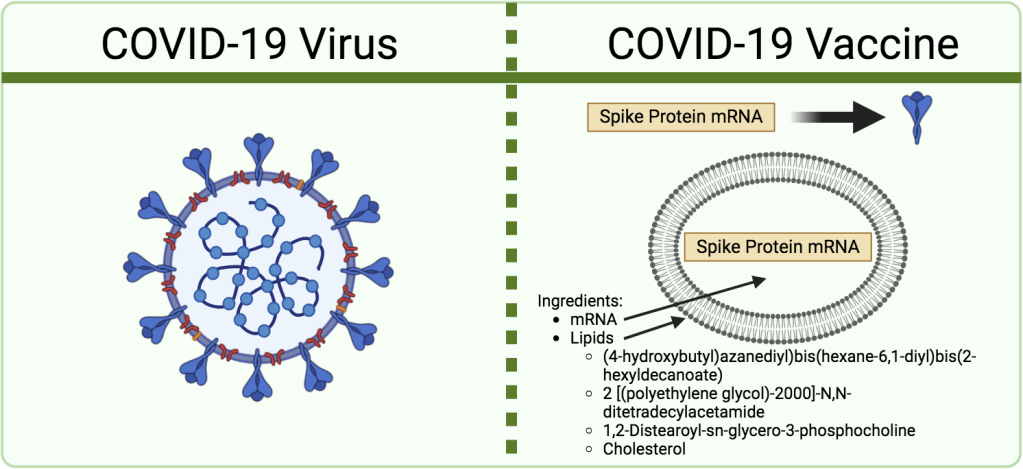
So what can you do? You can get vaccinated. The vaccine introduces only the exterior spike protein, from COVID-19, to the body (Figure 2). Therefore, your immune system will recognize, attack, and build antibodies against it. All occur freely, without the immune system disruption observed in COVID-19 infection, which requires the entire virus particle. Following vaccination, your body contains antibodies made to target COVID-19, so upon infection, you don’t have to wait for your immune system to try and react (especially since the data says your immune system will fail to produce sufficient antibodies), but instead, your body immediately targets and destroys the virus particles. The reason for the number and frequency of vaccines is two-fold: the virus’s spike protein changes over time, so our antibodies may not recognize it anymore, and antibodies have a life span, so you need at minimum yearly boosters to maintain immunity.
The only way to have a fighting chance against COVID-19, build up antibodies, or gain immunity is to get vaccinated. Because getting infected, if you survive, leaves you with no long-term immunity (since you won’t build up antibodies against it from an infection). Your other option is to let COVID-19 injure6 and age7 your brain because Ivermectin will not help.8
REFERENCES
1. Kaneko N, Kuo HH, Boucau J, Farmer JR, Allard-Chamard H, Mahajan VS, et al. Loss of Bcl-6-Expressing T Follicular Helper Cells and Germinal Centers in COVID-19. Cell. 2020;183(1):143-57 e13.
2. Lax SF, Skok K, Zechner P, Kessler HH, Kaufmann N, Koelblinger C, et al. Pulmonary Arterial Thrombosis in COVID-19 With Fatal Outcome : Results From a Prospective, Single-Center, Clinicopathologic Case Series. Ann Intern Med. 2020;173(5):350-61.
3. Guan WJ, Ni ZY, Hu Y, Liang WH, Ou CQ, He JX, et al. Clinical Characteristics of Coronavirus Disease 2019 in China. N Engl J Med. 2020;382(18):1708-20.
4. Ryg-Cornejo V, Ioannidis LJ, Ly A, Chiu CY, Tellier J, Hill DL, et al. Severe Malaria Infections Impair Germinal Center Responses by Inhibiting T Follicular Helper Cell Differentiation. Cell Rep. 2016;14(1):68-81.
5. Popescu M, Cabrera-Martinez B, Winslow GM. TNF-alpha Contributes to Lymphoid Tissue Disorganization and Germinal Center B Cell Suppression during Intracellular Bacterial Infection. J Immunol. 2019;203(9):2415-24.
6. Michael BD, Dunai C, Needham EJ, Tharmaratnam K, Williams R, Huang Y, et al. Para-infectious brain injury in COVID-19 persists at follow-up despite attenuated cytokine and autoantibody responses. Nat Commun. 2023;14(1):8487.
7. Mavrikaki M, Lee JD, Solomon IH, Slack FJ. Severe COVID-19 is associated with molecular signatures of aging in the human brain. Nat Aging. 2022;2(12):1130-7.
8. Naggie S, Boulware DR, Lindsell CJ, Stewart TG, Slandzicki AJ, Lim SC, et al. Effect of Higher-Dose Ivermectin for 6 Days vs Placebo on Time to Sustained Recovery in Outpatients With COVID-19: A Randomized Clinical Trial. JAMA. 2023;329(11):888-97.
 Fresh Science Explained
Leave a comment