
How well can you control the activity of a specific brain region? For example, the amygdala, the fear and aggression center in our brains. If you are easily frightened, the answer is not well. However, what if you could be trained using advanced technology and psychological techniques?1,2 Would you still be frightened? Let’s find out.
Three takeaways to tell your friends:
- To measure activity in specific brain regions, hospitals and labs use functional Magnetic Resonance Imaging (fMRI) machines.
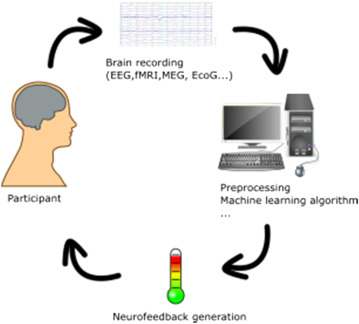
- Patients being able to visualize their amygdala activity while in an fMRI machine and practice increasing and decreasing that activity is neurofeedback training.1,2
- In a clinical trial, after training to control their amygdala activity, post-traumatic stress disorder (PTSD) patients had a significantly lower PTSD test scores.1
The amygdala is the region of the brain known to influence fear, anxiety, and aggression. Therefore, it is a common therapeutic target, especially for post-traumatic stress disorder (PTSD). PTSD is a long-term disorder caused by a traumatic event. The symptoms are vast but revolve around an increase in the fight-or-flight response in any trauma-related situations, so fear, nervousness, aggression, and more led by the activity of the amygdala. The goal of this study was to conduct neurofeedback training on PTSD patients to teach them to control their amygdala activity.
To achieve this goal, researchers used an fMRI machine to monitor amygdala activity. The activity is shown to the patients while it’s measured. Allowing the patients to “feel” low and high amygdala activity emotionally. This way, the patient begins learning how to regulate their amygdala activity. That is neurofeedback training.2 Visually represented below (Figure 1), you could think about it this way. Imagine you are riding a bike, but as you go faster, the ground becomes rockier and more uneven. As you slow down, the ground becomes smoother and easy to ride. You will learn to ride slower, as it’s more comfortable, like how PTSD patients are learning to regulate their amygdala activity to a comfortable level.
As a result, PTSD patients who underwent neurofeedback training had significantly less active amygdalar brain regions than the control group 30 days after training.1 Additionally, PTSD scores significantly dropped in the neurofeedback training group 60 days after training.1 As the results of a clinical trial, this proves that neurofeedback training can provide relief to PTSD patients. Additionally, there is compelling data from the clinical trial on MDMA and PTSD.
If you want to learn more about neurofeedback training, here is an explanation and an example.
REFERENCES
1. Zhao Z, Duek O, Seidemann R, Gordon C, Walsh C, Romaker E, et al. Amygdala downregulation training using fMRI neurofeedback in post-traumatic stress disorder: a randomized, double-blind trial. Transl Psychiatry. 2023;13(1):177.
2. Gerin MI, Fichtenholtz H, Roy A, Walsh CJ, Krystal JH, Southwick S, et al. Real-Time fMRI Neurofeedback with War Veterans with Chronic PTSD: A Feasibility Study. Front Psychiatry. 2016;7:111.
3. Loriette C, Ziane C, Ben Hamed S. Neurofeedback for cognitive enhancement and intervention and brain plasticity. Rev Neurol (Paris). 2021;177(9):1133-44.


Leave a Reply