
What’s the difference between being afraid of bears while camping in the forest and being afraid of bears while flying home? The former, known as conditioned fear, is based on logic and experience: “Bears are apex predators and live in this forest.” While the latter, known as generalized fear, is not. Generalized fear is your brain overreacting to a fearful stimulus. In a lab setting, mice will receive many electric shocks in a specific environment called cage A. The mice then display fearful behaviors in cage A since they associate that environment with pain. However, the same mice will show fear in a vastly different environment, cage B. This is called generalized fear, which is present in many anxiety and stress-related disorders such as post-traumatic stress disorder (PTSD).1 Today, we will dive into new findings regarding the mechanisms of generalized fear, showing how neurons change their biochemical profile in response to fear. By the end of this, you will understand neurotransmitter signaling.
Three takeaways to tell your friends:
- Some individual serotonin neurons in the brain can release multiple neurotransmitters (serotonin, glutamate, and GABA).
- Following five strong foot shocks these serotonin neurons, in the brains of mice, switch from releasing more glutamate to releasing more GABA.2
- This “glutamate-GABA switch” results in generalized fear behaviors in mice but can be prevented by promptly treating these mice with an antidepressant.2
In your brain right now, there are thousands and thousands of neurons sending signals to each other to comprehend this sentence. What a waste. You may wonder how neurons send signals, also called firing. Neurons are electrically charged cells, incredibly sensitive to the chemical balances around them. They rely on this sensitivity to know when to fire. The signals they receive either prevent them from firing (inhibitory) or trigger their firing (excitatory). These “signals” are typically neurotransmitters produced in neurons. After being produced, neurotransmitters are shuttled into vesicles, waiting to be released from the cell (Figure 1). Once their cell fires, the vesicles fuse with the cell’s membrane, and the neurotransmitters within the vesicles are pushed out of the cells like air emptying from a balloon. The effect on neighboring neurons depends on which neurotransmitter is released.
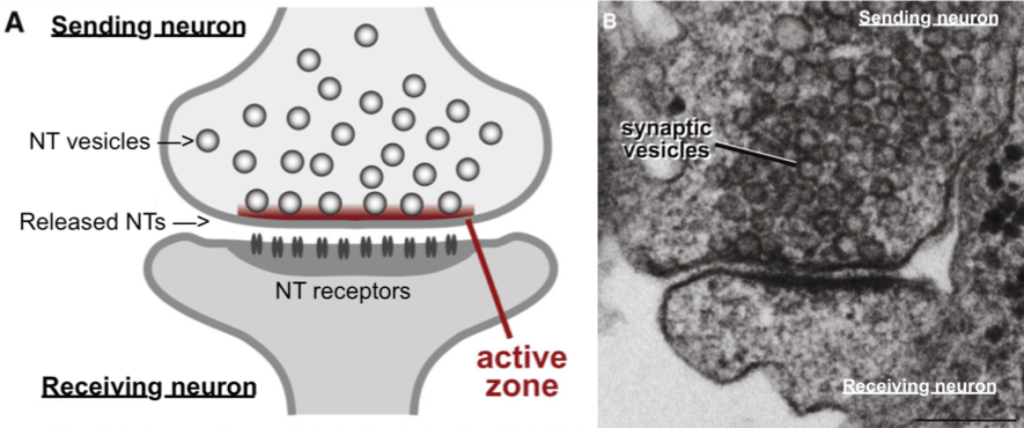
There are many compounds, like neurotransmitters, that neurons release. But you won’t need to know that for the test. The two major neurotransmitters released by neurons are glutamate and GABA. Glutamate is the most common excitatory neurotransmitter in the brain, telling other neurons to fire more, while GABA is the most common inhibitory neurotransmitter in the brain and does the opposite. Neurons for both neurotransmitters are spread throughout the brain, but what about the others, like dopamine, serotonin, acetylcholine, and norepinephrine? Each of those neurotransmitter systems has a specific pathway of signaling through the brain, from hubs to signaling sites. For example, serotonin’s hub is located in the brain stem (near the spinal cord) in a region known as the raphe nuclei. The neurons here produce and release serotonin. In a sub-region known as the dorsal raphe, the serotonin neurons can also release glutamate and GABA.5 Turns out that under control conditions, these neurons are more prepared to release glutamate than GABA; however, in this study, they found that after mice receive five strong foot shocks, their neurotransmitter profile changes.2 They begin producing and releasing significantly more GABA and less glutamate.2 They called this the glutamate-GABA switch. Along with the switch, the mice that received strong foot shocks displayed significant generalized fear.2
Ok, so here’s what we know so far:
- Serotonin neurons in the dorsal raphe can release serotonin, glutamate, and GABA.5
- Mice that received five strong foot shocks displayed generalized fear.2
- Mice that received five strong foot shocks switched their dorsal raphe serotonin neurons from releasing more glutamate to more GABA.2
- Mice experiencing generalized fear have serotonin neurons with a switched neurotransmitter profile.2
Now, so what? Well, preventing the glutamate-GABA neurotransmitter switch significantly decreased levels of generalized fear.2 So, it is clear that generalized fear from a traumatic task is directly associated with the glutamate-GABA switch. Now, what can we do to prevent the switch from occurring? Well, treating the mice with a common antidepressant medication like fluoxetine, brand name Prozac, prevented the glutamate-GABA switch ONLY if treatment begins promptly following trauma.2 When Fluoxetine treatment started two weeks after the trauma, the glutamate-GABA switch occurred and the mice retained generalized fear.2
In summary, when a traumatic experience occurs, that fear can radiate into other contexts, called generalized fear. This study shows that generalized fear potentially occurs as a result of serotonin neurons in a specific location switching their neurotransmitter profiles. Their levels of glutamate decrease while their GABA levels rise. However, this “glutamate-GABA switch” can be prevented by PROMPT treatment with the antidepressant Prozac (Figure 2).

I look forward to future research uncovering treatments that reverse the glutamate-GABA switch, as it may explain many disorders for which the mechanisms remain unknown. Just in case, have some breathing exercises prepared.
REFERENCES
1. Asok A, Kandel ER, Rayman JB. The Neurobiology of Fear Generalization. Front Behav Neurosci. 2018;12:329.
2. Li HQ, Jiang W, Ling L, Pratelli M, Chen C, Gupta V, et al. Generalized fear after acute stress is caused by change in neuronal cotransmitter identity. Science. 2024;383(6688):1252-9.
3. Sudhof TC. The presynaptic active zone. Neuron. 2012;75(1):11-25.
4. Kaeser PS, Deng L, Wang Y, Dulubova I, Liu X, Rizo J, et al. RIM proteins tether Ca2+ channels to presynaptic active zones via a direct PDZ-domain interaction. Cell. 2011;144(2):282-95.
5. Fu W, Le Maitre E, Fabre V, Bernard JF, David Xu ZQ, Hokfelt T. Chemical neuroanatomy of the dorsal raphe nucleus and adjacent structures of the mouse brain. J Comp Neurol. 2010;518(17):3464-94.
 Fresh Science Explained
Leave a comment