
Asperger’s syndrome, Autism, Autism Spectrum Disorder, what do they mean? Essentially the same thing. Dr. Hans Asperger published the first mentions of autistic behavior, hence Asperger’s syndrome, but fuck that guy. He worked with and supported nazi policies and eugenics in general. Plus, people were making fun of his name too often, so we advanced to Autism Spectrum Disorder (ASD) or just autism. ASD describes the collection of possible symptoms and behaviors observed in individuals, whereas plain autism is considered more severe and limiting. These symptoms and behaviors vary in type and severity from person to person, thus creating a spectrum of autism. However, one consistency among autistic individuals tends to be their perceptions of sensory information: touch, noise, smell, taste, etc. When fielding a questionnaire for kids aged 3-6 who were either autistic or typically developing, 95% of the autistic kids had an altered sensory perception score.1 In today’s study, a team of researchers recreated this sensitivity, in mice, by mutating an autism-associated gene.
Three takeaways to tell your friends:
- Mutating a glutamate receptor subunit, GRIN2B, results in autistic sensory behaviors in mice.2
- Mutating GRIN2B resulted in a more excitable and connected Anterior Cingulate Cortex (ACC), or pain center of the brain.2
- Inhibiting activity in the ACC in mutated-GRIN2B mice brains results in normal excitability, connectivity, and sensitivity.2
Within the brain, neurons are signaling constantly. Some neurons tell other neurons to signal more (excitatory), while others tell neurons to signal less (inhibitory). The most prominent family of excitatory neurons are known as glutamate neurons, which produce and release the major neurotransmitter glutamate. When glutamate interacts with one of its receptors on the receiving neuron, it will have an excitatory effect. When bound to glutamate, these receptors allow ions like calcium to rush into the cell, which is what causes the excitatory effect. Modifications to one specific subunit of these receptors, known as the glutamate receptor subunit epsilon-2 (GRIN2B), may predispose people to numerous cognitive and neurodevelopmental disorders3: ADHD,4 OCD,5 Schizophrenia,6 and poignantly autism.7,8 Given this information, researchers generated “autistic” mutated-GRIN2B mice to uncover its relation to autism.
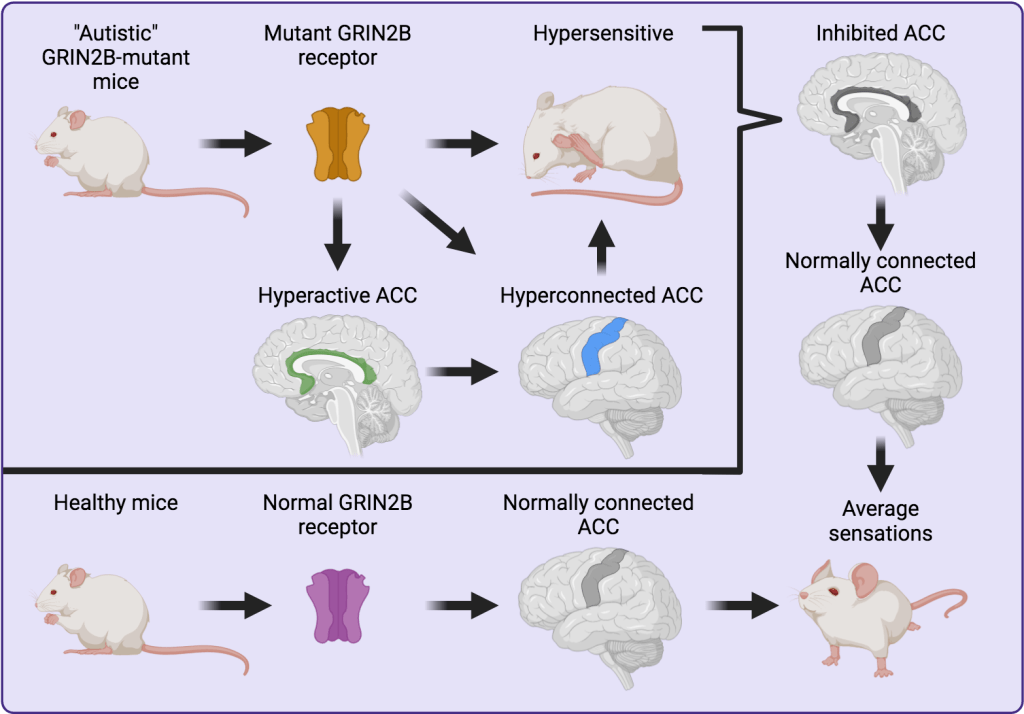
Knowing autistic individuals are more sensitive than average, researchers recorded mutated-GRIN2B mice responses to physical sensation tests. On each test (mechanical, electrical, and heat), the mutated-GRIN2B mice’s results showed they were more sensitive to the stimuli.2 Notably, upon testing the mutated-GRIN2B mice, their brain signals increased due to the activities and stress; however, amongst all brain regions, there was a significant increase in the Anterior Cingulate Cortex (ACC).2 The ACC is a massively important hub in the brain, known for chronic pain and error detection,9 among other things. To test if this increased excitability in the ACC influenced the sensitive behaviors in the mutated-GRIN2B mice, the researchers blocked most glutamate neuron activity in the ACC. As a result, the hypersensitive behaviors in the GRIN2B-mutant mice vanished.2
A frequent talking point with autism is the possibility of over-connected neurons. When observing the connectivity of ACC neurons with surrounding brain regions, the researchers found that the mutated GRIN2B mice had a hyperconnected ACC.2 Again, they blocked most glutamate neuron activity in the ACC, and the result showed normalized connectivity in the ACC.2
Altogether, along with the presence of GRIN2B in early development, this mutation may cause hyperactivity and hyperconnectivity within the ACC, resulting in a hypersensitive organism (Figure 1).
I found a cool database with every gene associated with autism, categorized by correlation strength!7 Also, no, I don’t speak Norwegian, but the internet does.
REFERENCES
1. Tomchek SD, Dunn W. Sensory processing in children with and without autism: a comparative study using the short sensory profile. Am J Occup Ther. 2007;61(2):190-200.
2. Lee S, Jung WB, Moon H, Im GH, Noh YW, Shin W, et al. Anterior cingulate cortex-related functional hyperconnectivity underlies sensory hypersensitivity in Grin2b-mutant mice. Mol Psychiatry. 2024.
3. Hu C, Chen W, Myers SJ, Yuan H, Traynelis SF. Human GRIN2B variants in neurodevelopmental disorders. J Pharmacol Sci. 2016;132(2):115-21.
4. Dorval KM, Wigg KG, Crosbie J, Tannock R, Kennedy JL, Ickowicz A, et al. Association of the glutamate receptor subunit gene GRIN2B with attention-deficit/hyperactivity disorder. Genes Brain Behav. 2007;6(5):444-52.
5. Arnold PD, Rosenberg DR, Mundo E, Tharmalingam S, Kennedy JL, Richter MA. Association of a glutamate (NMDA) subunit receptor gene (GRIN2B) with obsessive-compulsive disorder: a preliminary study. Psychopharmacology (Berl). 2004;174(4):530-8.
6. Ohtsuki T, Sakurai K, Dou H, Toru M, Yamakawa-Kobayashi K, Arinami T. Mutation analysis of the NMDAR2B (GRIN2B) gene in schizophrenia. Mol Psychiatry. 2001;6(2):211-6.
7. Abrahams BS, Arking DE, Campbell DB, Mefford HC, Morrow EM, Weiss LA, et al. SFARI Gene 2.0: a community-driven knowledgebase for the autism spectrum disorders (ASDs). Mol Autism. 2013;4(1):36.
8. O’Roak BJ, Vives L, Fu W, Egertson JD, Stanaway IB, Phelps IG, et al. Multiplex targeted sequencing identifies recurrently mutated genes in autism spectrum disorders. Science. 2012;338(6114):1619-22.
9. Bliss TV, Collingridge GL, Kaang BK, Zhuo M. Synaptic plasticity in the anterior cingulate cortex in acute and chronic pain. Nat Rev Neurosci. 2016;17(8):485-96.
 Fresh Science Explained
Leave a comment