
We all know the importance of omega-3, omega-6, and omega-9 fatty acids, right? You take fish oil supplements to provide your body with the omega-3s it cannot produce, and eat more unsaturated fats for the omega-6s it cannot produce. Great! You also happen to be protecting yourself from mood disorders like depression and bipolar disorder (BPD).1,2
Three takeaways to tell your friends:
- Our bodies produce omega-9 fatty acids but must obtain omega-3s and omega-6s from the diet.
- Omega-3s and omega-6s are highly protective and crucial for a healthy diet.
- Lower levels of an omega-6 fatty acid, arachidonic acid, can cause bipolar disorder.1
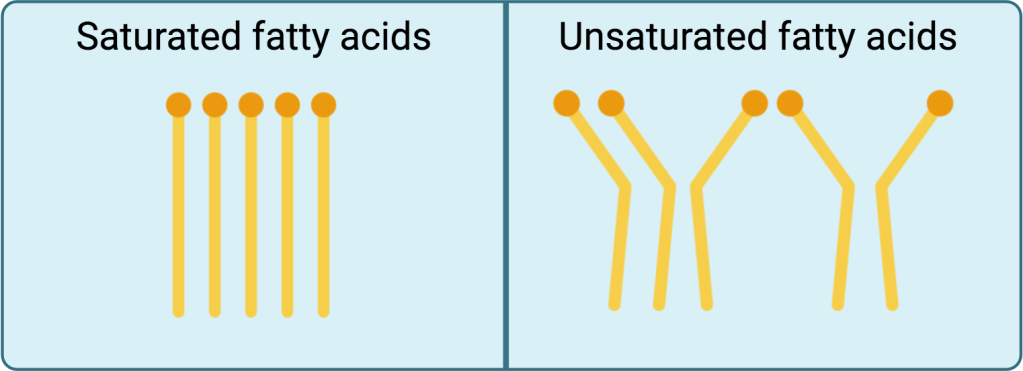
Firstly, what are fatty acids, and why are they saturated and unsaturated? Fatty acids are long connections of carbon molecules that we use to form the membranes for cells or break down for energy, among other uses. They tend to be saturated or unsaturated, referring to whether they would be dense or porous if lined up together (Figure 1). You see, saturated fatty acids are nearly identical, so they pack tightly and are tough to break down, leading to health problems down the line. Whereas unsaturated fatty acids have a kink in their long carbon chain, leaving a porous, easy-to-breakdown structure, making energy easily accessible for our cells. All omegas are unsaturated fats. While monounsaturated and polyunsaturated fats are healthy but not named by the omega system. Named for their number of kinks, monounsaturated fats contain one kink, while polyunsaturated fats contain more than one. Kinks are healthy in fats and life. Next time you look at nutritional facts, look for more unsaturated fats and less saturated and trans fats.
Unsaturated fats are healthier? So what? So is running a mile when you wake up, but sleeping feels much better. Well, unsaturated fats can have immense health benefits:
- Omega-3s prevent heart attack and other cardiovascular diseases.3
- Omega-3s slow the loss of kidney function in kidney disease.4
- Omega-3s and 6s improve rheumatoid arthritis symptoms.5
- Omega-3s lower blood pressure, with the effect proportionate to the blood pressure level.6
- Omega-3s improved symptoms in ulcerative colitis patients.7
- Unsaturated fatty acids can help type 2 diabetes patients regain insulin resistance without adverse blood glucose effects.3
- The loss of equilibrium between omega-3s and omega-6s is directly associated with depression.2
But wait, there’s more. In a recent study, a group of researchers examined an existing correlation8,9 between bipolar disorder prevalence and an omega-6 fatty acid, arachidonic acid (ARA) (pronounced uh-rack-uh-don-ick). Initially, they analyzed a study of 41,917 BPD cases10 to assess which metabolites in the human body correlate with BPD. ARA came up as 12 of the 33 metabolites.1 One being the free form or ARA, and 11 other metabolites containing ARA.1 Eight metabolites contained linoleic acid, an omega-6 fatty acid that becomes ARA. All-in-all, lower levels of ARA and metabolites containing ARA increase the risk for BPD.1 Further analysis shows lithium, the treatment for BPD, will have an improved response in patients with higher levels of ARA.1 Together, this analysis thoroughly implicates lack of ARA with BPD.
ALWAYS be aware that correlation does not prove causation. This association, normally, would not prove that lack of ARA causes BPD; however, they conducted this study using a revolutionary computerized technique, Mendelian randomization,11 allowing us to make supported causal inferences. Mendelian randomization works by eliminating possible confounding variables, testing mutants of ARA, searching for backdoor effects on BPD, and maintaining certain assumptions. If all assumptions are met, the researcher can infer a causal relationship. In this case, loss of the ARA pathway can cause BPD.
If you are now concerned about your diet, no need to fear. There is an informative section about increasing your ARA levels in a review by Djuricic & Calder 202112 titled “Effects of Increased Intake of Arachidonic Acid.” Here’s a snippet: “a recent systematic review of studies conducted in adults concluded that increasing [ARA] intake to as much as 1000–1500 mg/day had no adverse effect on platelet aggregation and blood clotting, immune function and markers of inflammation.13 In fact, some benefits of additional [ARA] on cognitive function have been reported14“12 (p. 8)
REFERENCES
1. Stacey D, Benyamin B, Lee SH, Hypponen E. A Metabolome-Wide Mendelian Randomization Study Identifies Dysregulated Arachidonic Acid Synthesis as a Potential Causal Risk Factor for Bipolar Disorder. Biol Psychiatry. 2024.
2. Davyson E, Shen X, Gadd DA, Bernabeu E, Hillary RF, McCartney DL, et al. Metabolomic Investigation of Major Depressive Disorder Identifies a Potentially Causal Association With Polyunsaturated Fatty Acids. Biol Psychiatry. 2023;94(8):630-9.
3. Simopoulos AP. Essential fatty acids in health and chronic disease. Am J Clin Nutr. 1999;70(3 Suppl):560S-9S.
4. Donadio JV, Jr., Bergstralh EJ, Offord KP, Spencer DC, Holley KE. A controlled trial of fish oil in IgA nephropathy. Mayo Nephrology Collaborative Group. N Engl J Med. 1994;331(18):1194-9.
5. Kremer JM. Effects of modulation of inflammatory and immune parameters in patients with rheumatic and inflammatory disease receiving dietary supplementation of n-3 and n-6 fatty acids. Lipids. 1996;31 Suppl:S243-7.
6. Morris MC, Sacks F, Rosner B. Does fish oil lower blood pressure? A meta-analysis of controlled trials. Circulation. 1993;88(2):523-33.
7. Stenson WF, Cort D, Rodgers J, Burakoff R, DeSchryver-Kecskemeti K, Gramlich TL, et al. Dietary supplementation with fish oil in ulcerative colitis. Ann Intern Med. 1992;116(8):609-14.
8. Bavaresco DV, Uggioni MLR, Simon CS, Colonetti T, Ferraz SD, Cruz MVB, et al. Evaluation of the arachidonic acid pathway in bipolar disorder: a systematic review. Mol Biol Rep. 2020;47(10):8209-17.
9. Messamore E, Almeida DM, Jandacek RJ, McNamara RK. Polyunsaturated fatty acids and recurrent mood disorders: Phenomenology, mechanisms, and clinical application. Prog Lipid Res. 2017;66:1-13.
10. Mullins N, Forstner AJ, O’Connell KS, Coombes B, Coleman JRI, Qiao Z, et al. Genome-wide association study of more than 40,000 bipolar disorder cases provides new insights into the underlying biology. Nat Genet. 2021;53(6):817-29.
11. Zhu Z, Zheng Z, Zhang F, Wu Y, Trzaskowski M, Maier R, et al. Causal associations between risk factors and common diseases inferred from GWAS summary data. Nat Commun. 2018;9(1):224.
12. Djuricic I, Calder PC. Beneficial Outcomes of Omega-6 and Omega-3 Polyunsaturated Fatty Acids on Human Health: An Update for 2021. Nutrients. 2021;13(7).
13. Calder PC, Campoy C, Eilander A, Fleith M, Forsyth S, Larsson PO, et al. A systematic review of the effects of increasing arachidonic acid intake on PUFA status, metabolism and health-related outcomes in humans. Br J Nutr. 2019;121(11):1201-14.
14. Ishikura Y, Ikeda G, Akimoto K, Hata M, Kusumoto A, Kidokoro A, et al. Arachidonic acid supplementation decreases P300 latency and increases P300 amplitude of event-related potentials in healthy elderly men. Neuropsychobiology. 2009;60(2):73-9.
 Fresh Science Explained
Leave a comment