
If you counted the number of bacterial cells in your gut, it would be ten times more than the total number of other cells in your body.1 At that proportion, one would expect them to have essential functions. Over the past 15 years, there has been an expansive dive into the effects of gut bacteria on the brain. Today, you will learn about a study that transferred gut bacteria from socially anxious humans to cause social anxiety in mice.
Three takeaways to tell your friends:
- Mice received gut bacteria from humans with social anxiety via fecal microbiota transplantation (FMT).2
- Mice that received bacteria from socially anxious humans lost a significant amount of oxytocin, the love hormone, neurons.2
- Mice that received bacteria from socially anxious humans showed increased social fear compared to mice that received gut bacteria from healthy humans.2
Gut bacteria seem to have an immense impact on the brain. They alter an essential neuronal protein.3,4 They rescue neuron signaling deficits.5 Proper socialization requires gut bacteria.6 The gut regulates the body’s stress response7 while identifying a specific bacterial species responsible.7 There is no denying that gut bacteria influence the brain.
How would you feel if I told you your medication was to eat a healthy stranger’s poop? Welcome to the magical world of fecal microbiota transplantation (FMT). FMT consists of collecting fecal matter from healthy individuals and delivering it to diseased patients. Now, before you picture something grotesque, the fecal matter is processed and placed in capsules, commonly to be digested like a standard pill.8 In more severe cases, the pills can be delivered directly to the intestine via a suppository. Proven to treat 85 diseases,8 this method started over 1600 years ago to treat fever and food poisoning,9 FMTs as a treatment continue to grow in popularity.8,9 Using FMTs, scientists can prove that gut bacteria play a part in specific ailments.
Gut bacteria directly influence social dynamics.10,11 The scientists in this study advanced previous correlational findings10,11 to prove that gut bacteria causes social fear. They took FMTs from both healthy humans and humans suffering from social anxiety disorder (SAD) and then delivered both to mice. This way, if the mice treated with SAD FMTs begin displaying symptoms of social disorders, it is safe to say that the gut bacteria from SAD donors caused this response.
In this study, researchers delivered human FMTs to mice from healthy humans or humans with SAD. The SAD mice contained significantly different bacteria than the healthy mice.2 The SAD mice displayed lower levels of the proteins necessary to keep harmful chemicals out of the brain.2 The number of neurons that produce oxytocin, the love hormone, was decreased, along with overall oxytocin levels.2 Finally, sociability was comparable between the healthy and SAD FMT mice,2 and the results were telling.
To detail a social fear conditioning experiment, FMT mice are placed in a crate with a foreign mouse in a wire cage within (Figure 1). Each time the FMT mouse interacts with the foreign mouse, the FMT mouse receives a shock. This deters the mouse from interacting, hence social anxiety. Following the conditioning, the mice return to their home cage with a new neighbor, a foreign mouse in a wire cage (Figure 1). The researchers then measure the total time the mouse spends interacting with the foreign mouse. The more time spent interacting, the less social “anxiety” and the greater the ability to overcome fear. The less time spent interacting, the more social “anxiety” and the worse the ability to overcome fear. The mice who received FMTs from anxious humans (SAD FMT) spent significantly less time interacting with the other mice after receiving shocks;2 therefore, the SAD FMT mice developed social fear.
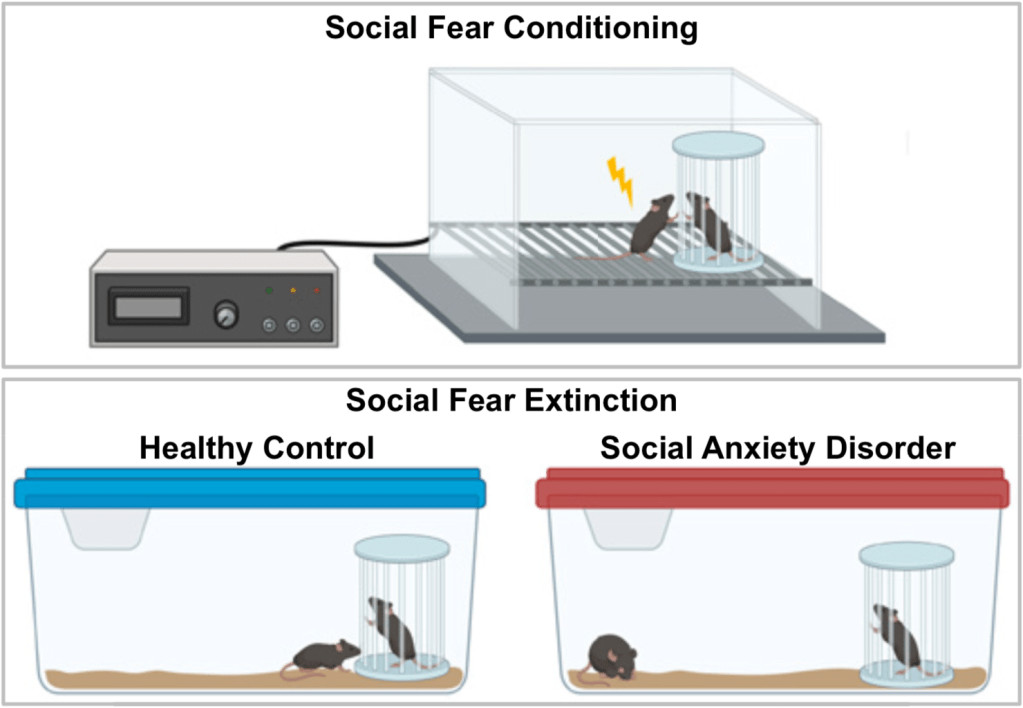
In summary, transferring gut bacteria from an individual with SAD to a mouse will likely cause social anxiety in the mouse.2 Additionally, these SAD FMT mice have significantly lower levels of oxytocin in a brain region involved in anxiety and fear.2 The potential for FMTs is limitless as we uncover how the gut microbiota influences the rest of the body.
REFERENCES
1. Savage DC. Microbial ecology of the gastrointestinal tract. Annu Rev Microbiol. 1977;31:107-33.
2. Ritz NL, Brocka M, Butler MI, Cowan CSM, Barrera-Bugueno C, Turkington CJR, et al. Social anxiety disorder-associated gut microbiota increases social fear. Proc Natl Acad Sci U S A. 2024;121(1):e2308706120.
3. Arentsen T, Raith H, Qian Y, Forssberg H, Diaz Heijtz R. Host microbiota modulates development of social preference in mice. Microb Ecol Health Dis. 2015;26:29719.
4. Bercik P, Denou E, Collins J, Jackson W, Lu J, Jury J, et al. The intestinal microbiota affect central levels of brain-derived neurotropic factor and behavior in mice. Gastroenterology. 2011;141(2):599-609, e1-3.
5. Buffington SA, Di Prisco GV, Auchtung TA, Ajami NJ, Petrosino JF, Costa-Mattioli M. Microbial Reconstitution Reverses Maternal Diet-Induced Social and Synaptic Deficits in Offspring. Cell. 2016;165(7):1762-75.
6. Desbonnet L, Clarke G, Shanahan F, Dinan TG, Cryan JF. Microbiota is essential for social development in the mouse. Mol Psychiatry. 2014;19(2):146-8.
7. Wu WL, Adame MD, Liou CW, Barlow JT, Lai TT, Sharon G, et al. Microbiota regulate social behaviour via stress response neurons in the brain. Nature. 2021;595(7867):409-14.
8. Zhang F, Cui B, He X, Nie Y, Wu K, Fan D, et al. Microbiota transplantation: concept, methodology and strategy for its modernization. Protein Cell. 2018;9(5):462-73.
9. Wang Y, Zhang S, Borody TJ, Zhang F. Encyclopedia of fecal microbiota transplantation: a review of effectiveness in the treatment of 85 diseases. Chin Med J (Engl). 2022;135(16):1927-39.
10. Butler MI, Bastiaanssen TFS, Long-Smith C, Morkl S, Berding K, Ritz NL, et al. The gut microbiome in social anxiety disorder: evidence of altered composition and function. Transl Psychiatry. 2023;13(1):95.
11. Sherwin E, Bordenstein SR, Quinn JL, Dinan TG, Cryan JF. Microbiota and the social brain. Science. 2019;366(6465).
 Fresh Science Explained
Leave a comment