Many people in the world struggle due to a single faulty gene. Single genes are responsible for countless diseases like hemophilia, cystic fibrosis, muscular dystrophy, and diabetes. Today, we will discuss a revolutionary method of hijacking a common signaling pathway, allowing the operator to produce genes of their choosing from implanted stem cells. In this study, producing insulin to treat Type-1 diabetes.
Three takeaways to tell your friends:
- Antioxidants remove Reactive Oxygen Species (ROS) from cells.
- Type-1 diabetic mice treated with the DART system continued to have healthy blood glucose every day after receiving a daily ten-second electric DART signal.1
- Compared to control mice, when treated with the DART system, mice had indistinguishable amounts of sugar attached to blood proteins,1 a common test for diabetes.
Type-1 diabetes is an extremely common disease resulting from the loss of the Insulin gene.2 Type-1 diabetes is easily treatable, provided insulin doesn’t cost $1000 each month. But what if newly implanted cells in your body could produce all the insulin you need? Well, you would not need to worry about buying more. Based on their estimates, you only need to buy three AA batteries every five years.1 I know what you are thinking. “I am not battery operated,” but you may want to be after this.
There are hundreds of signaling pathways in our cells. Some produce positive outcomes, some remove negative nellies. Reactive Oxygen Species (ROS) are a prominently removed group. Made from reactions happening every second in our bodies, these ROS will damage cells if not removed.3 More recently recognized as a source of Parkinson’s disease pathology.4 Have you ever wondered why everyone says, “You should take more antioxidants?” Maybe it’s because the function of antioxidants is to destroy ROS. But don’t worry, our bodies produce antioxidant genes on their own. When ROS levels become high, a specific protein goes on a mission to make antioxidant genes; in this study, they hijacked the ROS pathway to produce insulin.

Typically, to produce genes, a promoter is activated. The promoter is a DNA sequence adjacent to the gene’s DNA sequence. Remember that everything is made up of DNA, including genes. Now imagine that all of the proteins needed to produce a gene are members of the Avengers, and activating the promoter is the equivalent of saying “Avengers Assemble.” The activation of the promoter assembles all necessary proteins for gene production.
In the ROS pathway, a specific protein binds to a promoter that will produce antioxidants. So, these researchers switched the antioxidant gene with the Insulin gene. Now, when ROS levels are high, the cells will produce insulin instead of antioxidants. And we are still talking about cells in petri dishes. We would never do this to cells in your body. But what if we implanted those cells under the skin, in a drug-permeable coating, safe from the body’s immune system? Then, after creating ROS, your body would have all the insulin it needs.
It turns out that shocking the cells with low voltage electricity 4.5 Volts for 10s can produce significant ROS.1,5 Using this method, stem cells successfully produced insulin in Petri dishes. They called this method DART, or electrical ROS creation stimulating insulin production.
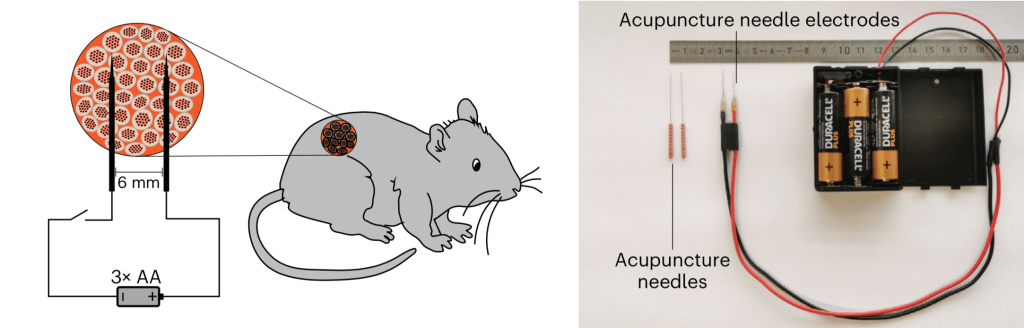
Finally, the stem cells were implanted into the backs of type-1 diabetic mice, with the acupuncture electrodes placed within; the voltage was reached using three AA batteries1 see below. The mice received the electric current once a day for 10s. Within two days, until the end of the experiment (28 days), the mice had normal blood glucose levels. Five weeks after daily treatment, the amount of sugar-coated blood proteins (a measure of diabetes) was no different in healthy mice. Ten seconds of electricity a day can treat type-1 diabetes. Now, there are similar studies showing success at treating type-1 and type-2 diabetes,6 but this study is proof of something bigger than diabetes.
This study proves that we can deliver a gene of our choice to the body as desired. There are many steps to take before then, but imagine if we could produce the gene for people suffering from diseases caused by the loss of a single gene: Hemophilia, which lacks factor 8 or 9; Cystic fibrosis, which lacks CFTR; Muscular dystrophy, which lacks dystrophin. Obviously, it’s not that easy. The genes need to travel to the proper locations: blood, lungs, and muscles, respectively. There is plenty to consider, but this is a neat step forward.
Answers to questions you may have:
- No damage came to the tissue surrounding the site of cell implantation.
- Stimulation did not impact the surrounding cells.
- Stimulation with sticky patches on the skin instead of needles did not produce insulin.
- The amount of ROS produced is relatively small, and they showed that the ROS did not increase cell death in Petri dishes at the levels of electricity.
REFERENCES
1. Huang J, Xue S, Buchmann P, Teixeira AP, Fussenegger M. An electrogenetic interface to program mammalian gene expression by direct current. Nat Metab. 2023;5(8):1395-407.
2. Katsarou A, Gudbjornsdottir S, Rawshani A, Dabelea D, Bonifacio E, Anderson BJ, et al. Type 1 diabetes mellitus. Nat Rev Dis Primers. 2017;3:17016.
3. Yang S, Lian G. ROS and diseases: role in metabolism and energy supply. Mol Cell Biochem. 2020;467(1-2):1-12.
4. Picca A, Guerra F, Calvani R, Romano R, Coelho-Junior HJ, Bucci C, et al. Mitochondrial Dysfunction, Protein Misfolding and Neuroinflammation in Parkinson’s Disease: Roads to Biomarker Discovery. Biomolecules. 2021;11(10).
5. Patil RS, Juvekar VA, Naik VM. Oxidation of Chloride Ion on Platinum Electrode: Dynamics of Electrode Passivation and its Effect on Oxidation Kinetics. Industrial & Engineering Chemistry Research. 2011 Aug 2;50(23):12946–59.
6. Xie M, Ye H, Wang H, Charpin-El Hamri G, Lormeau C, Saxena P, et al. beta-cell-mimetic designer cells provide closed-loop glycemic control. Science. 2016;354(6317):1296-301.
 Fresh Science Explained
Leave a comment