
Stick with me for a breezy biochemistry overview while I guide you through gene production. First off, anxiety disorders are incredibly prevalent across the world, plaguing 25% of the population.1 Do you or someone you know suffer from anxiety? Most likely. The current treatments rely on prescription medications that do not always provide relief, have many side effects, and can lead to addiction and dependence; alternatives include mindfulness, yoga, relaxing teas, and therapy (which everyone should do). But again, these treatments may not be effective.
Three takeaways to tell your friends:
- Within your DNA are sequences with specified functions known as genes.
- Genes are regulated by short sequences of RNA known as microRNAs (miRNAs).
- A specific miRNA in a brain region known as the amygdala can prevent anxiety by limiting a gene known as Pgap2.2
Your entire genome lies within every cell in your body as tightly wrapped DNA. It’s so long that sequencing the entire genome took 13-years. Within the genome are sequences of DNA with specific functions. These are called genes. There are at least 17,000 genes in the human body,3 with some notable ones: insulin (INS), capsaicin receptor (TRPV1), and cannabinoid receptor 1 (CNR1). Gene production is a highly controlled process.
Gene regulation is complex, gaining more popularity and relevance by the year. One regulator is known as microRNAs (miRNAs). RNA instead of DNA because the miRNAs are single-stranded sequences of nucleotides, not double-stranded DNA sequences. How these miRNAs control genes is due to the nature of producing genes.
miRNAs are single-stranded sequences. When producing a gene, your body produces a single-stranded copy (RNA) of the gene’s DNA. If any region of the gene aligns with the miRNA sequence, the miRNA will latch onto the gene like a zipper and prevent its from functioning (Figure 1).

Some miRNAs directly influence anxious behaviors, specifically in the amygdala.4 The amygdala is a brain region known for processing emotional information and fear.5 This study focused on identifying miRNAs in the amygdala following stressful situations.
After stressing mice, they identified five miRNAs in the amygdala but focused on the most abundant one, miR-483-5p (pronounced [meer-483-5p]).2 After identification, they searched for genes suppressed by this miRNA. They found that miR-483-5p heavily suppressed a gene called Pgap2. To test the anxiety-reducing effects of miR-483-5p and Pgap2, they conducted an elevated plus maze test (Figure 2).

The elevated plus maze is a plus-shaped platform with two shielded “safe” extensions and two exposed “unsafe” extensions. The mice tend to travel between the safe extensions. However, when relieved of their anxiety, mice increase their exploration of unsafe extensions. The researchers track their movement and calculate the number of times the mice enter the unsafe extensions compared to the safe extensions. The more they enter the unsafe extensions, the less anxious we say they feel. Increasing the levels of miR-483-5p in the amygdala increases the mouse’s movements into the unsafe extension (Figure 3);2 therefore, increasing miR-483-5p levels decreases anxiety.
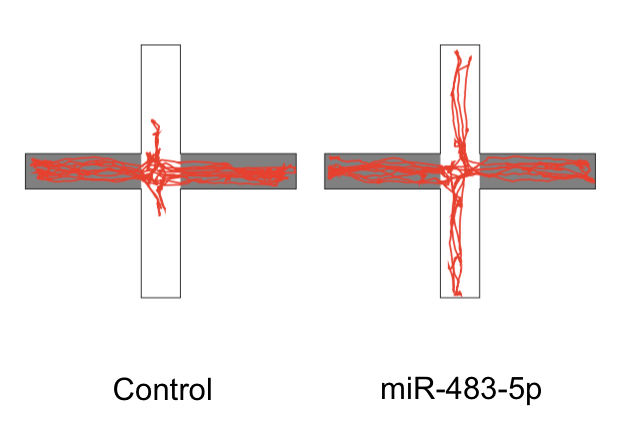
Knowing that miR-483-5p decreases Pgap2 production, they conducted the same experiment while directly limiting Pgap2 production. Limiting Pgap2 production decreased anxious behaviors as well.2
They repeated these elevated plus maze tests, following six hours of stress on the mice, to test if miR-483-5p and Pgap2 influence stress-induced anxiety. They saw the same results. The increased amount of miR-483-5p, which limits Pgap2, and the limited production of Pgap2 both resulted in decreased anxious behaviors.2
In summary, less Pgap2 production in the amygdala leads to less anxious behaviors, and miR-483-5p limits Pgap2 production.
So what now? Limit Pgap2 in humans? No. We don’t know what off-target effects may occur, and we need more than one behavioral test before moving forward. A lot of steps need to happen before utilizing this as a therapeutic, but identifying a single gene responsible for anxious behaviors is groundbreaking.
REFERENCES
1. Remes O, Brayne C, van der Linde R, Lafortune L. A systematic review of reviews on the prevalence of anxiety disorders in adult populations. Brain Behav. 2016;6(7):e00497.
2. Mucha M, Skrzypiec AE, Kolenchery JB, Brambilla V, Patel S, Labrador-Ramos A, et al. miR-483-5p offsets functional and behavioural effects of stress in male mice through synapse-targeted repression of Pgap2 in the basolateral amygdala. Nat Commun. 2023;14(1):2134.
3. Uhlen M, Fagerberg L, Hallstrom BM, Lindskog C, Oksvold P, Mardinoglu A, et al. Proteomics. Tissue-based map of the human proteome. Science. 2015;347(6220):1260419.
4. Haramati S, Navon I, Issler O, Ezra-Nevo G, Gil S, Zwang R, et al. MicroRNA as repressors of stress-induced anxiety: the case of amygdalar miR-34. J Neurosci. 2011;31(40):14191-203.
5. Janak PH, Tye KM. From circuits to behaviour in the amygdala. Nature. 2015;517(7534):284-92.
 Fresh Science Explained
Leave a comment