
The year is 2024. Roe v. Wade is long gone, and IVF is becoming illegal. Women with pregnancies that would prove to be fatal must travel across state lines to survive. I cannot believe it has come to this. The burden is on them to take birth control, but unintentional pregnancies still happen. While the only thing men can do is wear condoms and get vasectomies. Hopefully, this study advances that.
Three takeaways to tell your friends
- When sAC is inhibited in sperm from mice and humans in Petri dishes, their mobility and signal responses are lost.1
- When sAC is inhibited in live mice, sperm collected from the female uteri following sex has lost mobility and signal responses.1
- Following sAC inhibition by stomach administration, mice were 100% sterile for 15 minutes to 2.5 hours and reversed by 24 hours.1
Unintentional pregnancies are common. From 2015 to 2019, ~50% of all pregnancies, globally, were unplanned.2 It happens. What can we do to prevent it, not have sex? Ha good one, but seriously what can we do? Well, women have the brunt of the responsibility. Most that I know take birth control pills daily or implant an IUD. While all men can do is wear condoms that may break. What if, additionally, men could take a time-released sterilizing pill?
The male contraceptive is a heavily sought-after feat. The most common options focus on hormones; however, those have many side effects.3 The focus has shifted toward non-hormonal options affecting sperm function, like our study. But, like hormonal methods, the sterilization effect and reversal take several weeks.4 Of note, a non-hormonal natural compound showed effective contraception in monkeys weeks later.5
But how do you temporarily sterilize men? Well, you inhibit the sperm’s function. Upon ejaculating, a signaling response occurs due to soluble Adenylyl Cyclase (sAC). This process is necessary for sperm maturation.6 The concept is to inhibit sAC function to prevent sperm maturation and function.

sAC is present in every cell and is essential for cellular functions. How can they inhibit a vitally functioning protein without having immense side effects? Great question. It’s simple yet fascinating. sAC is identical in nearly all cells, except the testis and sperm.6 sAC in the testis and sperm contains an extra region within its gene. Now, researchers can search for inhibitors that bind to that extra region in the sAC gene. And so they did.
The inhibitor showed no toxicity at high doses or doses over long periods.1 First, they analyzed mouse and human sperm in petri dishes. When treated with sAC inhibitor, the mouse and human sperm cells lost mobility and sAC signal responses.
But we are here to learn about taking a pill. This time, researchers administered the inhibitor by spraying it into the back of the mice’s mouth while surgically collecting their sperm an hour later. Again, the sperm cells had no mobility or sAC signal responses.
But what about ejaculated sperm? Since the sperm is now significantly diluted and distanced from the inhibitor. They gave the inhibitor by direct stomach injection, similar to taking a pill. But now they set up mating pairs and collected the sperm from the female’s uteri following sex. Yet, the results are consistent, showing that sperm cells lose mobility and signal responses.
Similar mating pairs were set up to discern the length of time of sterility in the mice. The inhibitor was again given directly to the stomach via injection and mice were left to mate with their partners. They had shown, using this method of injection, that 15 minutes after injection the sperm mobility was nearly zero, and that lasted through 2.5 hours. We will call this the “sterile time frame”. At 24 hours after injection, the percentage of mobile sperm had returned near baseline.1 Using this information, they paired up mice for specific times after injection, see table. As expected, 0% of the mice in the inhibitor-treated sterile time frame group were pregnant.1 In comparison, 30% of the mice in the placebo-treated sterile time frame group were pregnant. In the 24-hour and beyond group the inhibitor-treated and placebo-treated groups found 87% and 93% of the mice pregnant, respectively.1 See the table below. Additionally, the offspring from the recently inhibitor-treated mice “matured normally”; therefore, the mice had returned to normal fertility.

In conclusion, this contraceptive sterilizes mice from 15 minutes after administration up to 2.5 hours. The effect reverses and allows for fertilization 24 hours later. The age of male contraceptives has begun.
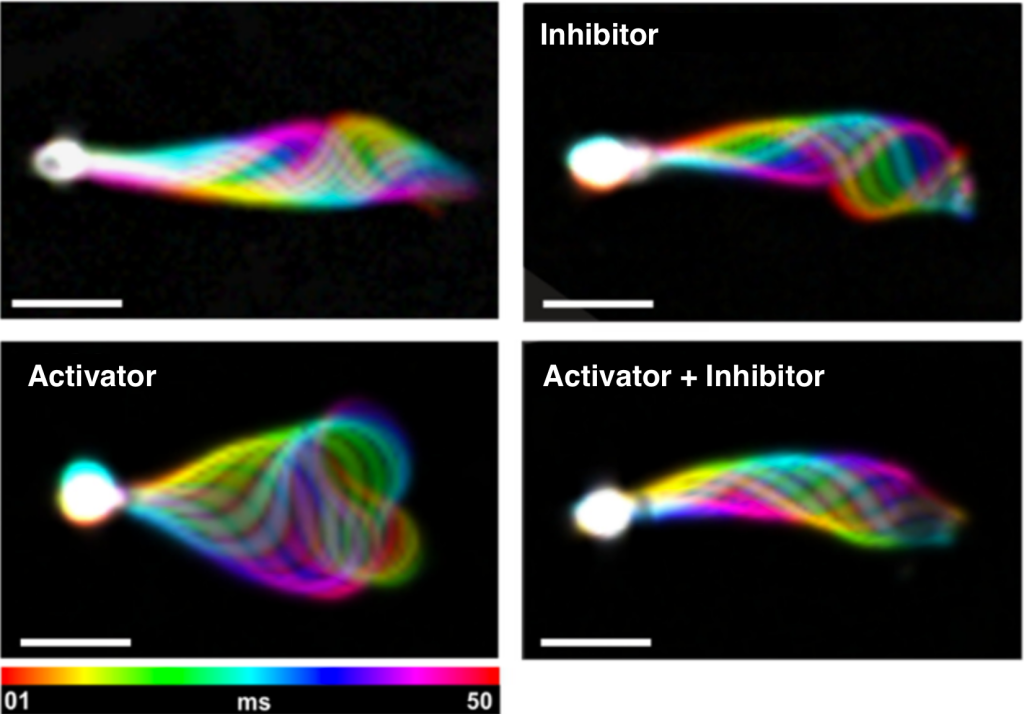
For fun, here are images reflecting the movement of individual human sperm cells when activated (with signals), inhibited, neither, or both.1 Notice the widespread movement following activation and the loss of that movement with the addition of the inhibitor. Enjoy the pretty colors!
My takeaways from the study:
- They repeatedly stated that mouse behaviors were unaffected by the inhibitor but never showed data to support that.
- I imagine clinical trials will start shortly.
- sAC seems like a safe and effective method for temporary male sterility.
- sAC is no excuse to avoid wearing condoms; wrap your tool, hooligans.
REFERENCES
1. Balbach M, Rossetti T, Ferreira J, Ghanem L, Ritagliati C, Myers RW, et al. On-demand male contraception via acute inhibition of soluble adenylyl cyclase. Nat Commun. 2023;14(1):637.
2. Bearak J, Popinchalk A, Ganatra B, Moller AB, Tuncalp O, Beavin C, et al. Unintended pregnancy and abortion by income, region, and the legal status of abortion: estimates from a comprehensive model for 1990-2019. Lancet Glob Health. 2020;8(9):e1152-e61.
3. Behre HM, Zitzmann M, Anderson RA, Handelsman DJ, Lestari SW, McLachlan RI, et al. Efficacy and Safety of an Injectable Combination Hormonal Contraceptive for Men. J Clin Endocrinol Metab. 2016;101(12):4779-88.
4. Liu PY, Swerdloff RS, Anawalt BD, Anderson RA, Bremner WJ, Elliesen J, et al. Determinants of the rate and extent of spermatogenic suppression during hormonal male contraception: an integrated analysis. J Clin Endocrinol Metab. 2008;93(5):1774-83.
5. Chang Z, Qin W, Zheng H, Schegg K, Han L, Liu X, et al. Triptonide is a reversible non-hormonal male contraceptive agent in mice and non-human primates. Nat Commun. 2021;12(1):1253.
6. Ferreira J, Levin LR, Buck J. Strategies to safely target widely expressed soluble adenylyl cyclase for contraception. Front Pharmacol. 2022;13:953903.
 Fresh Science Explained
Leave a comment