
Three takeaways to tell your friends:
- Sesaminol is an antioxidant with anti-cancer properties.1
- Pretreatment with sesaminol protects cells from oxidative stress, a hallmark of PD pathology.1
- In a PD mouse model, a diet containing sesaminol preserved motor functions and dopamine neurons while minimizing alpha-synuclein aggregates.1
Parkinson’s Disease (PD) is a debilitating neurological disease that worsens until death. PD is caused by the loss of a specific type of neuron (Dopamine), in a specific brain region (the Substantia Nigra). The loss of dopamine neurons in the substantia nigra, dysregulates the normal signaling pathway controlling body movement, which leads to the symptoms of Parkinson’s Disease: slowness of movement, rigidity, tremors, and impaired posture/balance.1
Preventing the destruction of the dopamine neurons in the substantia nigra would prevent PD entirely. The best available treatment for PD is L-Dopa, which treats symptoms until you build up a tolerance. Then it no longer helps treat symptoms. Therefore, researchers are looking for a more reliable, potentially preventative, treatment for PD.
The death of dopamine neurons in the substantia nigra is tied to the production of Reactive Oxygen Species (ROS) by many different pathways that result in oxidative stress.2 Oxidative stress occurs when ROS causes cellular damage by interacting with molecules when the body’s natural antioxidant system cannot handle the amount of ROS.3
Imagine a cell as a large wooden ball, with ROS representing bouncing rubber band balls within. Antioxidants would be people removing rubber bands from the rubber band balls to minimize their bouncing. Oxidative stress depicts the damage done to the large wooden ball.
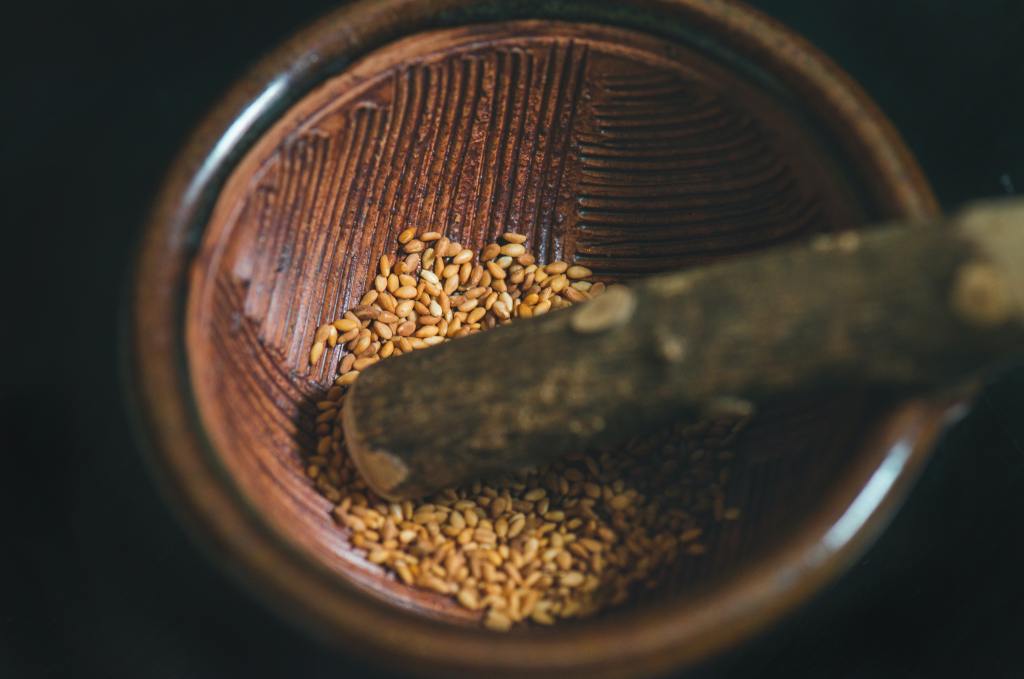
In today’s study, they tested if a known antioxidant and anti-cancer extract4 from sesame seeds, sesaminol, would protect the cells from PD pathology.
To mimic a cellular environment with oxidative stress, as observed in PD, the researchers added 6-hydroxydopamine (6-OHDA) to their cell cultures. 6-OHDA enters cells through dopamine transporters and then converts to an ROS. Upon addition of 6-OHDA, more cell death occurred that pretreatment of sesaminol was able to prevent.1 Additionally, 6-OHDA significantly increased the amount of ROS within the cells, while 6-OHDA with sesaminol pretreatment kept the ROS at normal levels.1 As expected, with a decrease in ROS, sesaminol pretreatment also decreased overall oxidative stress.
Sesaminol did not fight the ROS on its own. It used natural cellular responses as well. In response to ROS, an antioxidant response element (ARE) moves into the nucleus. Upon treatment of 6-OHDA, ARE traveled to the nucleus, but following sesaminol pretreatment with 6-OHDA, a lot more ARE was observed.1 In addition, they showed another protein involved in the antioxidant response to ROS.1 It has significantly more activity following 6-OHDA treatment in combination with sesaminol pretreatment.1 Thus, sesaminol improves the cell’s antioxidant defense against ROS.
To obtain PD-like symptoms in mice, they consume rotenone. This results in motor deficits, the death of dopamine neurons, and the presence of alpha-synuclein.5 Alpha-synuclein is known to misfold, form aggregates, and cause dysfunctions within dopamine neurons leading to cell death, essentially PD.6 In this study, a rotenone diet resulted in motor deficits, dopamine neuron degeneration, and more alpha-synuclein aggregates.1 However, in a combination diet of rotenone with sesaminol, motor functions remained similar to control, dopamine neurons populated the substantia nigra, and alpha-synuclein deposits were significantly fewer.1
This publication provides evidence supporting sesaminol as an effective and preventative measure in the fight against PD pathology. Begging the question, can sesaminol be used as a treatment if your symptoms are present? The authors utilized sesaminol as a pretreatment for these experiments, but, given its effectiveness, we must test its success following the presence of PD symptoms. I mean, what are we waiting for? What do you want? Do you want the moon? Just say the word, and I’ll throw a lasso around it and pull it down. Am I talking too much? Yes.

Fun fact, like Alois Alzheimer,8 James Parkinson9 discovered the symptoms of Parkinson’s Disease and was credited with the discovery by having the disease named after him.
The amounts of drugs used in experiments: 20µM 6-OHDA, 1µg/mL Sesaminol.
REFERENCES
1. Kaji H, Matsui-Yuasa I, Matsumoto K, Omura A, Kiyomoto K, Kojima-Yuasa A. Sesaminol prevents Parkinson’s disease by activating the Nrf2-ARE signaling pathway. Heliyon. 2020;6(11):e05342.
2. Naoi M, Maruyama W. Cell death of dopamine neurons in aging and Parkinson’s disease. Mech Ageing Dev. 1999;111(2-3):175-88.
3. Poljsak B, Suput D, Milisav I. Achieving the balance between ROS and antioxidants: when to use the synthetic antioxidants. Oxid Med Cell Longev. 2013;2013:956792.
4. Miyahara Y, Hibasami H, Katsuzaki H, Imai K, Osawa T, Ina K, et al. Sesaminol from sesame seed induces apoptosis in human lymphoid leukemia Molt 4B cells. Int J Mol Med. 2001;7(5):485-8.
5. Betarbet R, Sherer TB, MacKenzie G, Garcia-Osuna M, Panov AV, Greenamyre JT. Chronic systemic pesticide exposure reproduces features of Parkinson’s disease. Nat Neurosci. 2000;3(12):1301-6.
6. Stefanis L. alpha-Synuclein in Parkinson’s disease. Cold Spring Harb Perspect Med. 2012;2(2):a009399.
7. Capra, Frank, director. It’s a Wonderful Life. Liberty Films, 1947, Accessed 17 Feb. 2023.
8. Hippius H, Neundorfer G. The discovery of Alzheimer’s disease. Dialogues Clin Neurosci. 2003;5(1):101-8.
9. Goetz CG. The history of Parkinson’s disease: early clinical descriptions and neurological therapies. Cold Spring Harb Perspect Med. 2011;1(1):a008862.
 Fresh Science Explained
Leave a comment